The New Imperative of Energy Storage
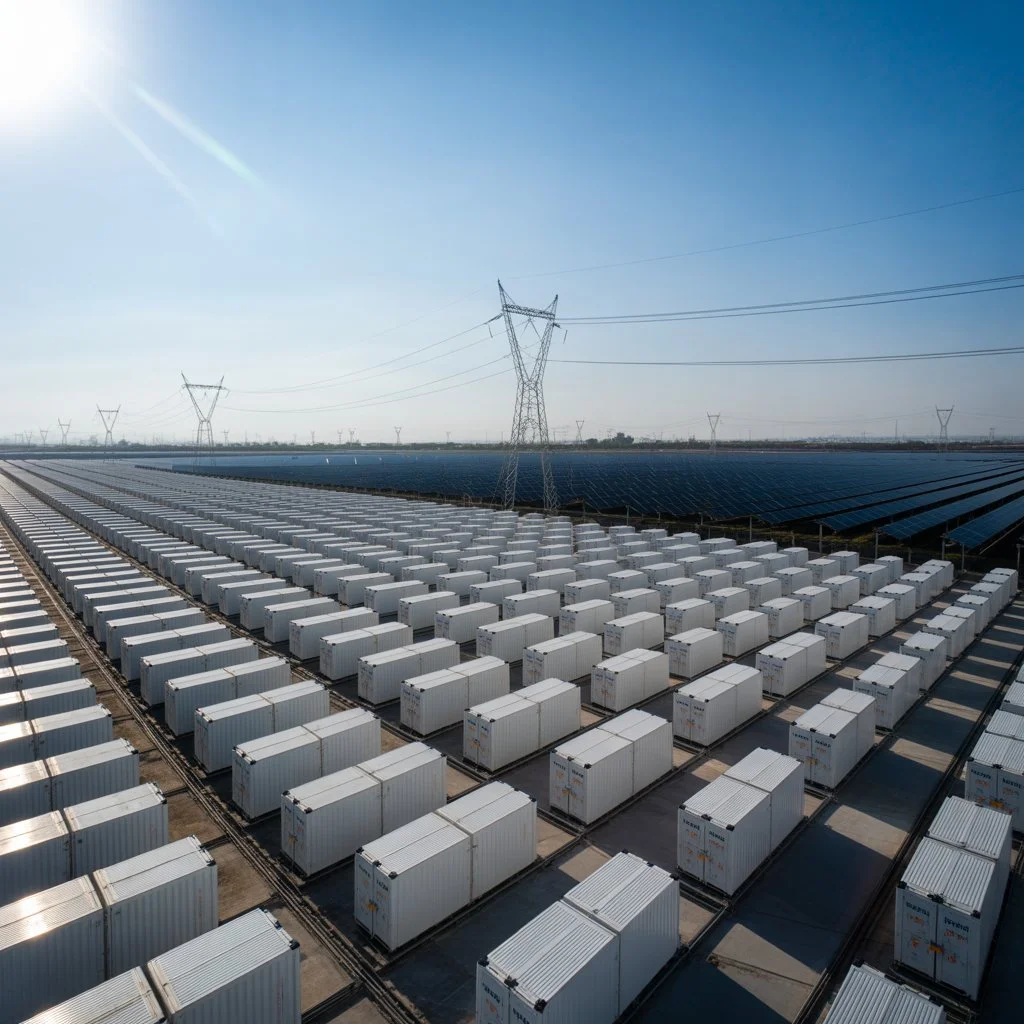
The global energy storage landscape has crossed a pivotal threshold. For the first time in history, annual installations surpassed 100 GW in 2025 — and the technologies, market forces, and engineering decisions that define 2026 will shape grid architecture for decades. This is not a moment for incremental thinking. It demands smart thinking.
A market that has come of age
Global storage deployments in 2025 reached a record 304 GWh, driven primarily by utility-scale battery energy storage systems (BESS) in China, the United States, and Europe. The U.S. alone installed more than 28 GW of stationary storage, representing a 29% year-on-year increase in energy capacity. With deployments forecast to reach 70 GWh / 35 GW in the U.S. by the end of 2026, the storage sector has left its pilot-project era firmly behind.
100 GW+ Global storage installations in 2025, for the first time in history
$75–80/kWh Utility-scale lithium-ion pricing in 2026
$5.12T Projected global storage market value by 2034
411 GW Projected cumulative installed storage by 2030 (BNEF)
For the power engineer, these are not just headline numbers. They signal a fundamental change in how the grid is architected, controlled, and protected. Storage is no longer a supplement to generation — it has become a core dispatchable asset with its own market mechanisms, regulatory frameworks, and engineering requirements.
Grid-forming BESS: from curiosity to commercial necessity
Perhaps no single technology development defines this moment more precisely than grid-forming BESS. For years, grid-forming inverter control was a subject of academic interest and narrow pilot deployment.
In 2026, it has emerged as a commercial necessity — particularly where storage is deployed at scale in weak-grid environments or as the primary generation source.
Traditional grid-following BESS systems react to voltage and frequency deviations only after they occur, introducing inherent latency through a power plant controller loop that can span tens to hundreds of milliseconds.
Grid-forming BESS, by contrast, natively sets voltage and frequency, allowing the inverter to respond to load changes within milliseconds. In microgrid contexts, research has demonstrated voltage recovery within 300 ms and frequency deviations limited to ±0.5 Hz under grid-forming control — a performance standard that grid-following architectures cannot match under low short-circuit ratio conditions.
"The most structural shift in 2026 is storage moving from an incentivized asset to a legally mandated grid component — and with that shift comes the engineering obligation of grid-forming capability."
The emergence of data centers as gigawatt-scale, highly variable loads has accelerated this transition. GPU-intensive AI workloads exhibit rapid, unpredictable swings in power consumption that stress the interconnection infrastructure beyond its original design.
The most advanced grid-forming architectures can compensate for nearly 100% of the load transient rather than only partially mitigating the disturbance. For the power engineer designing interconnection solutions in 2026, grid-forming BESS is no longer a premium option. It is rapidly becoming the baseline specification.
Beyond lithium: the diversification imperative
Lithium-ion remains the dominant technology by installed capacity. Battery pack prices fell below $100/kWh at the utility-scale for the first time in 2024 and have continued their downward trajectory to $75–80/kWh today. Yet supply chain constraints and the geopolitical complexities surrounding lithium are reshaping procurement strategies across every major market.
Sodium-ion
CATL and BYD reached commercial production scale in 2023–24. Offers cost advantages and improved performance at temperature extremes. Mainstream arrival in 2026.
Iron-air
Now operating at commercial scale. Suited to 100+ hour long-duration storage needs. Targets 2040 LDES Council projection of 1.5–2.5 TW global need.
Flow batteries
Technology-specific RFPs are growing in California, Australia, Germany, Spain, and Ireland. Compelling for 8–16-hour durations with independent power/energy scaling.
Gravity storage
Competing in the long-duration segment. Projects reaching commercial operation. No electrochemical degradation. Highly site-specific.
The industry consensus is clear: four-hour batteries are no longer sufficient to support deep penetration of renewables. The LDES Council estimates the grid will require 1.5 to 2.5 TW of long-duration storage capacity by 2040. Engineers specifying storage systems today need to evaluate not only the near-term revenue stack but also the asset's role in providing multi-hour or multi-day flexibility as renewable penetration continues to increase.
AI, VPPs, and the rise of the smart energy solution
The integration of artificial intelligence into energy management systems represents a step-change in operational capability. Real-time demand forecasting, predictive maintenance, fault detection, and dispatch optimization are areas where AI is delivering measurable improvements in grid stability and asset utilization. AI-driven grid management technologies enable predictive maintenance and fault detection, reducing unplanned downtime and improving grid resilience — directly addressing the reliability requirements that utility engineers and system operators must meet.
At the distributed edge, virtual power plants (VPPs) aggregate behind-the-meter storage, EVs, and commercial BESS to form dispatchable portfolios that rival the flexibility of conventional generation. Australia's networks already manage hundreds of megawatts of VPP capacity.
Germany's aggregators are now managing over 15,000 decentralized units within a single network, and by 2026, those platforms will have transitioned from simple frequency response to real-time cross-market optimization — allowing household batteries to participate in wholesale energy trading with effectively no human operator involvement.
This is what a genuine smart energy solution looks like in practice: not a single product, but a system architecture in which storage assets, inverter controls, communication protocols, and AI-driven energy management operate as a coherent, self-optimizing whole.
For the engineer, this creates both the challenge of system integration and the opportunity to deliver capabilities that were simply not available to the grid a decade ago.
The regulatory and standards evolution
The 2026 National Electrical Code (NEC) brings targeted clarifications to Article 706 — Energy Storage Systems — reflecting the rapid evolution of the technology. These are refinements rather than wholesale revisions, but they underscore how storage standards continue to mature to meet field realities. In Europe, the updated Electricity Market Design rules require all EU Member States to submit Flexibility Needs Assessments by July 2026, setting concrete storage targets as a legal obligation.
State-level procurement mandates in the U.S. remain the most powerful driver of utility-scale deployment, with integrated resource planning reforms increasingly treating storage as a core grid resource rather than an optional complement.
Fire safety remains an area of active standards development. NFPA 855 and the emerging Large Format Storage Technology (LFST) standards are central to project bankability, particularly as project sizes continue to increase and co-location with other infrastructure becomes more common.
Engineering for the grid of 2030 — today
Smart thinking in energy storage engineering in 2026 means designing systems that perform optimally not only under today's grid conditions but under the grid conditions that will prevail at the end of the asset's operational life. A BESS commissioned today will operate into the mid-2030s. By that point, renewable penetration will be substantially higher, short-circuit ratios in many networks will be lower, and the value of grid-forming capability and long-duration flexibility will have increased considerably.
The engineers and organizations that will establish lasting authority in this field are those who approach storage not as a commodity procurement exercise, but as a systems engineering challenge — one that demands rigorous technical analysis of inverter topology, control architecture, thermal management, state-of-health modeling, and market optimization, pursued simultaneously and with genuine interdisciplinary depth.
The grid needs that kind of smart thinking. The transition depends on it.
smart energy, solution energy, storage, smart thinking BESS, grid-forming, long-duration storage, virtual power plants, NEC 2026, AI energy management.
Daniel SchwartzbergBMEnergy, founded by Daniel Schwartzberg, is driven by a commitment to delivering smart energy solutions that support energy for the future. Combining strong technical capability with commercial awareness and collaborative leadership, focus is placed on advancing practical innovation across the electrical power sector, maintaining proven industry foundations while enabling reliable, efficient, and forward-looking energy development.